
System Hub
Chilling, cooking, hot-holding

Fridge, freezer and probe temperature records for restaurants

Temperature records are dated logs of fridge, freezer, cooking, and hot-holding readings, with a name on the line. In the UK, chilled food must be kept at 8°C or below. A spreadsheet with no timestamp is not the same as a diary an EHO can read.

Last reviewed: . Reviewed by Nitin Patel. Drafts are prepared with AI assistance and checked by him before publication.

What temperature records do restaurants need?

Temperature records are dated readings for the equipment and processes in your SFBB pack: fridges, freezers, cooking, and hot-holding. They prove chilling and cooking happened, with a name on the line. They do not replace cooking food until it is safe.

Legal limits you should cite, not invent

The Food Standards Agency is the source. Do not treat a software default as the law.

Your SFBB pack may set tighter fridge limits. Record against the methods you actually use.

Record What to capture When
Fridge / freezer Unit, reading, who probed it Opening, and during the shift if the pack says so
Cooking Dish or batch, probe reading, who cooked it When you cook, not at close from memory
Hot-holding Unit, reading, who checked it While food is held hot
Deliveries Accept or reject, temperature if chilled, who signed When the delivery arrives

Clipboards and spreadsheets

Paper is legal. Clipboards go missing. Spreadsheets have no timestamps and no name on the line. Managers find those gaps after close, not during the shift. EHOs accept digital records when they are complete, dated, and accessible — not because the app is “approved”. Continuous wireless sensors are a different job — System Hub vs Checkit.

How System Hub logs temps

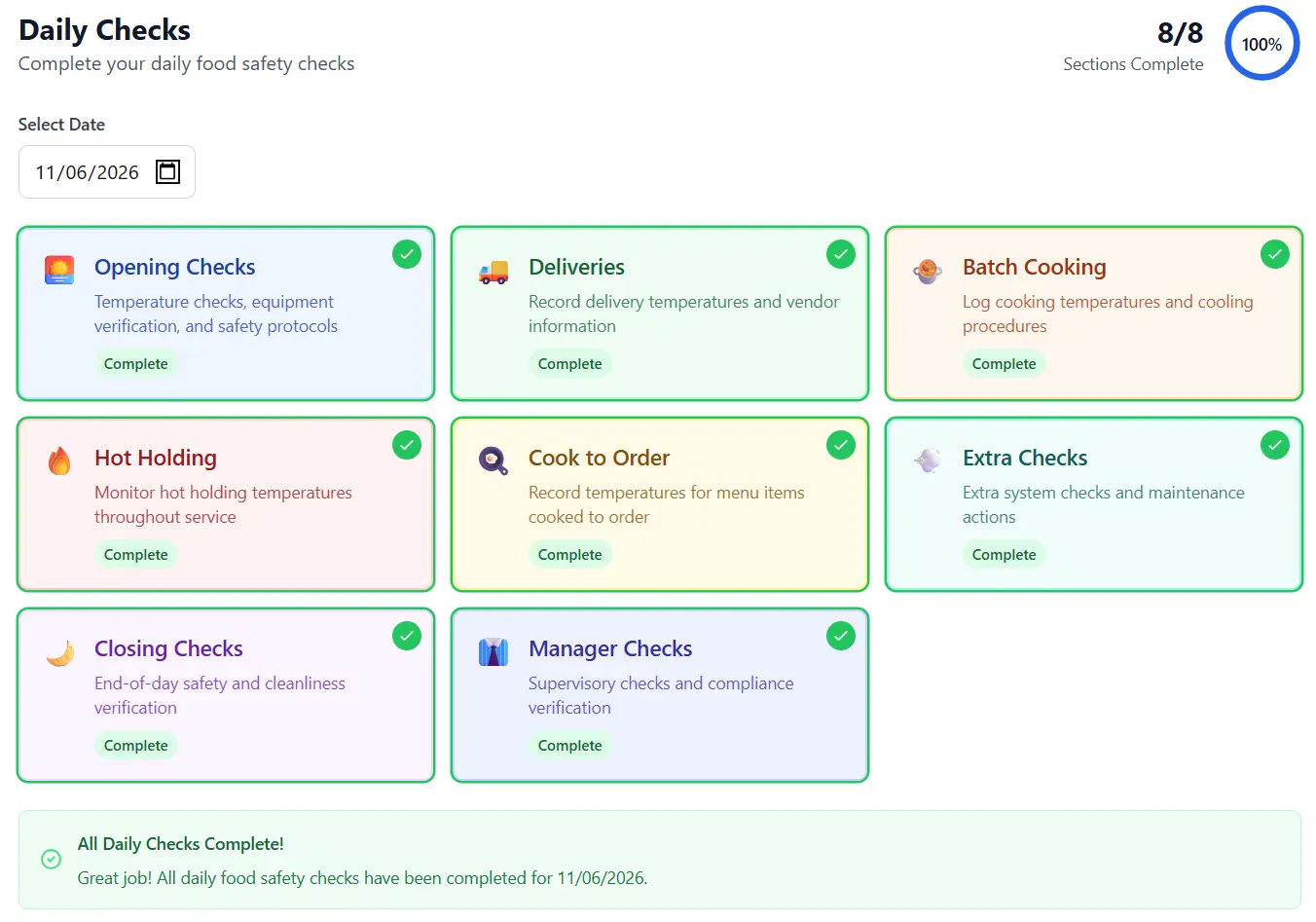
Guided fridge, freezer, cooking, and hot-holding checks on a phone, with limits you configure. Alerts when a check is skipped. Same SFBB diary as opening checks and the 4-weekly review. 14-day trial, no card, then £5/week per location incl VAT via Stripe.
What do you write when a fridge reads 12°C at 11:00?

Move the food, or prove it is still safe, and write both the reading and the action. A log that says 12°C with no next step is the page an officer stops on. Chilled food in the UK is kept at 8°C or below. Hot-holding is 63°C or above. Cooking until piping hot: the FSA gives 75°C for 30 seconds as one combination, not the only one.

Worked line, one walk-in, Tuesday service. 11:04, unit “walk-in 1”, 12°C, name of the person who probed it. 11:20, food moved to walk-in 2 which read 4°C, engineer called, same name. If the pack’s own limit is tighter than 8°C, record against that limit. Do not “correct” 12°C to 5°C at close.

Probe check is a separate line. If the probe reads 2°C out in iced water, the fridge reading that morning is not evidence. Record the probe check, then the food check. Deliveries of chilled food get an accept or reject, the temperature if you took one, and the name. A tick with no figure is not a temperature record.

The reading and the action sit on the same row.
A temperature with no figure is not a temperature record.
  • Chilled food: 8°C or below, unless your SFBB method is tighter.
  • Hot-holding: 63°C or above while food is on the pass.
  • Cooking: piping hot throughout. 75°C for 30 seconds is one FSA combination.
  • Out of range: the action is part of the record, not a note on a whiteboard.

FSA: chilling. FSA: cooking safely. Food Safety Act 1990, section 21 (due diligence).

Questions about temperature records

What temperature should a restaurant fridge be in the UK?
Chilled food must be kept at 8°C or below. That is the Food Standards Agency’s chilling rule. Many kitchens set a tighter limit (often 5°C) in their SFBB pack. Record the reading you took, not the limit you hoped for. Source: FSA chilling guidance.
What should a fridge temperature log include?
The equipment, the reading, the date and time, and who took it. Cooking and hot-holding logs sit in the same diary. A clipboard in a drawer with no name on the line is the record that fails when the EHO asks who probed the walk-in on Thursday.
Is a spreadsheet enough for temperature records?
A spreadsheet can be legal if it is complete, dated, and accessible. Most are not: no timestamps, no name on the line, and the file lives on a laptop that is not in the kitchen. Digital SFBB records with attributed checks are easier to hand over. See digital SFBB records.
How much is System Hub Food Safety?
14-day trial, no card. Then £5/week per location incl VAT via Stripe. Cancel anytime.